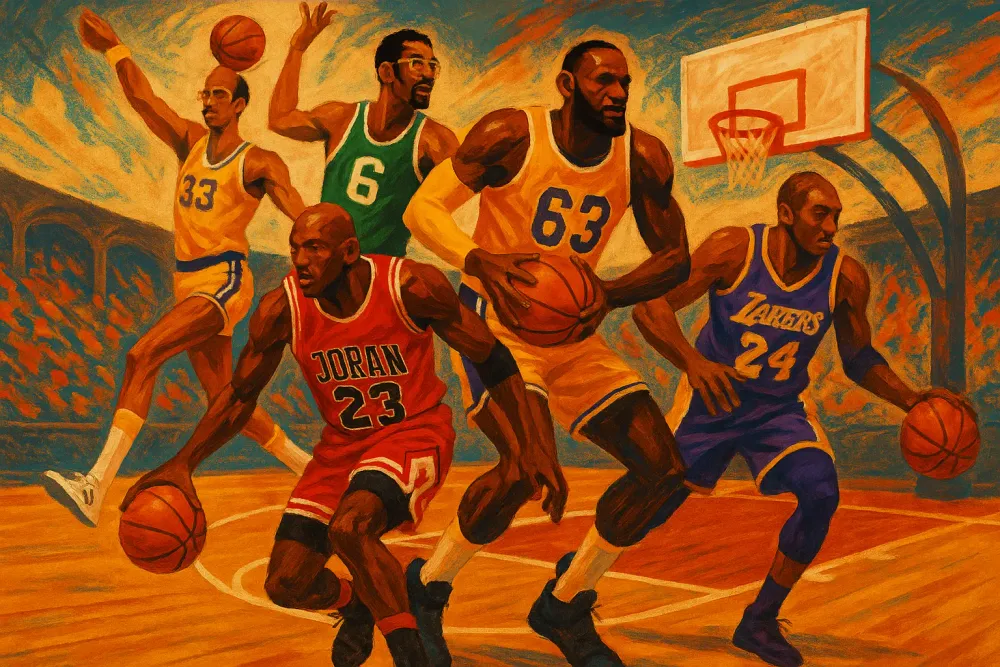
The debate over the title of the NBA's Greatest of All Time (GOAT) has raged for decades, frequently pitting Michael Jordan against LeBron James while occasionally including other legends like Bill Russell, Wilt Chamberlain, and Kareem Abdul-Jabbar. But a profound challenge underpins this discussion: the stark evolution of basketball across its eight-decade history. Each era has transformed the sport in ways that make direct comparisons between players from different times inherently problematic. Moreover, highlights from past eras often look like clips of an entirely different sport compared to today’s fast-paced, three-point shooting game.
A more insightful approach might involve segmenting the debate by decade. To that end, we created a scoring formula that gives credit to every player based on their MVP award shares, All-NBA selections, individual team success, win shares, as well as Defensive Player of the Year wins and All-Defensive team nods. Below, we explore this formula's results and recognize the top players from each decade, along with a closer look at the legends who defined their eras.
1950s: George Mikan
Beginning with the early years of the NBA, George Mikan stands out as a foundational figure. Known for his dominance in the paint, Mikan won the league's scoring title in each of his first three seasons. His impressive scoring average of 27.8 points and 3.2 assists, coupled with two championships in 1949 and 1950, solidified his legacy. Mikan’s impressive skill set was complemented by his physical prowess, a stark contrast to many of his contemporaries. His training included unorthodox methods such as speed bag punching and jumping rope, contributing to the emergence of big men as a dominant force in the league.
The top five players of the 1950s also included Max Zaslofsky, Joe Fulks, Jim Pollard, and Bob Feerick.
1960s: Bill Russell
Transitioning into the 1960s, Bill Russell's influence on defense became legendary. Even though Russell played only nine seasons in the decade, his impact was unparalleled. Averaging an astonishing 22.4 rebounds per game, Russell was the cornerstone of a Boston Celtics squad that captured eight championships. His defensive prowess was so intimidating that opponents frequently altered their shots out of fear of his presence. Described by teammate Sam Jones as someone who intimidated even the most skilled players, Russell's legacy is woven into the fabric of basketball history.
Other notable players from this era include Wilt Chamberlain, Oscar Robertson, Jerry West, and Elgin Baylor.
1970s: Kareem Abdul-Jabbar
The 1970s are dominated by Kareem Abdul-Jabbar, whose remarkable numbers include 28.2 points and 14.4 rebounds per game, along with six MVP awards. His signature skyhook shot and ironclad defensive skills made him a dual threat that few could rival. Abdul-Jabbar's ability to influence both offensive and defensive aspects of the game set a new standard for big men. Beyond his individual accolades, he remains one of the most influential players of all time, bridging the gap between previous and future generations of stars.
Joining him among the best of the decade were John Havlicek, Dave Cowens, Elvin Hayes, and Walt Frazier.
1980s: Larry Bird
As we move into the 1980s, the rivalry between Magic Johnson and Larry Bird epitomized a golden age of basketball. While both featured extensively in discussions of the decade's best player, Bird edged out Johnson largely due to his consistently high MVP shares, finishing top two in MVP voting for six consecutive seasons. Bird's scoring ability, basketball IQ, and clutch performances made him a formidable competitor who not only led his Celtics to three championships but captivated audiences with his all-around play.
Magic Johnson, Kareem Abdul-Jabbar, Moses Malone, and Michael Jordan also found themselves in the top ranks of this decade.
1990s: Michael Jordan
The 1990s presented a clear frontrunner in the GOAT debate: Michael Jordan. With an average of 30.3 points per game and six championships, his sheer dominance during this decade was unmatched. Jordan not only excelled statistically but also showcased an unwavering ability to deliver in high-pressure moments, playing a vital role in leading the Chicago Bulls to six titles. His competitive spirit and scoring prowess set standards for generations to come.
Prominent players of the 1990s also included Karl Malone, Scottie Pippen, David Robinson, and Hakeem Olajuwon.
2000s: Kobe Bryant
No decade discussion is complete without Kobe Bryant, who emerged as the standout player of the 2000s. Known for his tenacity and competitive drive, Bryant claimed multiple championships both as Shaquille O'Neal's sidekick and later as the key figure leading the Los Angeles Lakers. His resolve to become the top player in the league shone through as he secured two consecutive titles in 2009 and 2010. Comparisons to Michael Jordan were inevitable, but Kobe's fierce mentality and work ethic allowed him to carve out his own legacy.
Joining him in the top ranks were Tim Duncan, Shaquille O'Neal, Kevin Garnett, and LeBron James.
2010s: LeBron James
As we entered the 2010s, LeBron James continued to elevate his game. Maintaining impressive averages of 26.5 points, 7.7 rebounds, and 7.7 assists, LeBron's adaptability and basketball intelligence allowed him to thrive alongside a cadre of all-star teammates throughout the decade. His growth as a player and leader ultimately transformed him into an all-time great, culminating in four championships. The debate remains: is he the GOAT, or does that title still belong to Jordan?
The decade's elite also included Kevin Durant, James Harden, Stephen Curry, and Kawhi Leonard.
2020s: Nikola Jokić
In the present decade, Nikola Jokić is making a case for his place among the greats with eye-popping statistics and accolades. Dominating the scoreboard and showcasing remarkable versatility, Jokić is increasingly reshaping perceptions of how a center can play. His well-rounded game combines elite passing and scoring, and he leads the decade in multiple categories including points, rebounds, and assists. With several years still ahead, Jokić offers a tantalizing glimpse into what memories may lay ahead in NBA history.
Other top five players of this decade include Giannis Antetokounmpo, Shai Gilgeous-Alexander, Jayson Tatum, and Stephen Curry.
This exercise highlights the complex history of player excellence in the NBA using a methodology that spans decades. Arguments may arise regarding the weighting of various categories in the scoring system, but the discussion is fascinating as basketball continues to evolve, ensuring that the GOAT debate will remain active as future legends emerge.