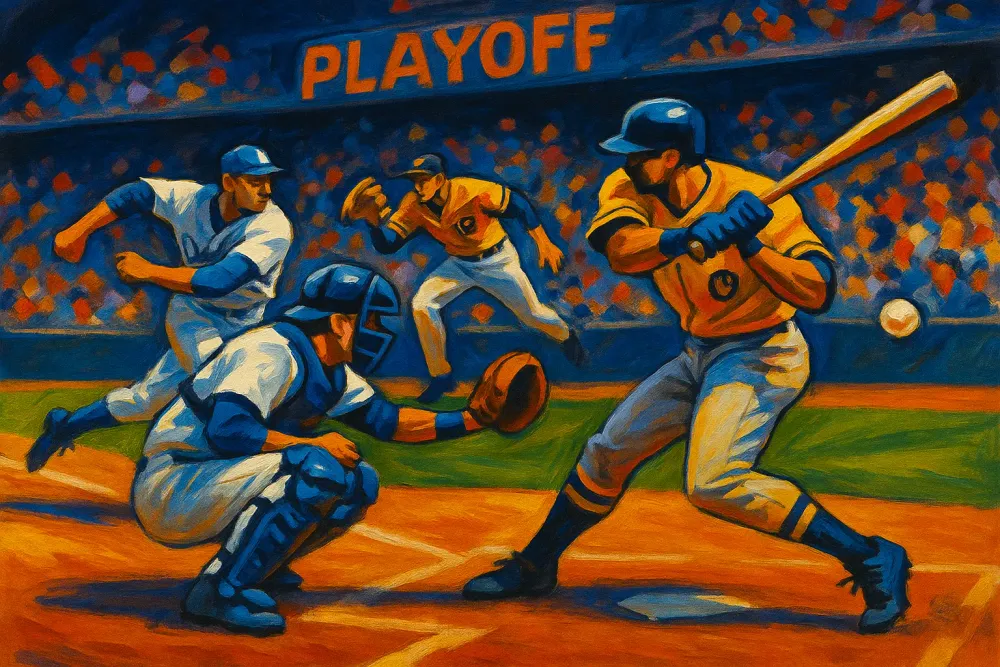
The National League Championship Series (NLCS) has taken an unexpected turn, as the Milwaukee Brewers find themselves on the cusp of a sweep against the heavily-favored Los Angeles Dodgers. After a dominating three games, the Brewers are leading the series 3-0, showcasing that a well-constructed team can triumph over a roster filled with high-priced talent.
Dodgers' Financial Might Meets Disappointment
In the world of Major League Baseball, few franchises boast the financial firepower of the Los Angeles Dodgers. With a staggering $500 million payroll, many expected the Dodgers to steamroll through the playoffs and secure a third consecutive World Series title. However, money alone does not ensure victory, particularly when faced with a formidable opponent like the Brewers.
Despite having a payroll of only $143.7 million, the Brewers have clearly been the better team in this postseason. From the start of the series, they overwhelmed the Dodgers by thoroughly defeating Los Angeles in the first two matchups. The Brewers managed to wear down pitchers Tarik Skubal and Yoshinobu Yamamoto, limiting the Dodgers to just a single extra-base hit. It was apparent that the Dodgers were more concerned with their massive budget than with the fundamentals of baseball.
Missteps in Dodgers' Management
The beating that the Dodgers have taken in this NLCS can largely be attributed to poor management decisions. Dave Roberts, the Dodgers' manager, faced scrutiny after failing to have faith in his bullpen during critical moments. In Game 3, his decision to rely on Blake Snell as he approached 100 pitches backfired spectacularly when the Brewers capitalized with back-to-back home runs, breathing life into their momentum and sending the Dodgers reeling.
This isn’t the first time the Dodgers have faltered in the postseason, despite their track record of success. Under president of baseball operations Andrew Friedman, who has helped the team secure the NL West 11 times in 12 seasons, one would expect a more cohesive strategy. Yet, the aging lineup, highlighted by Freddie Freeman and Mookie Betts, demonstrates the limits of their financial approach.
Shouldering the Blame
Critiques of the Dodgers are not without their complexities, as they are undeniably a well-run franchise. However, decisions made by the front office raise questions about their consistency and foresight. For instance, the acquisition of Kyle Tucker, a highly-regarded player whose four-year, $240 million contract raised eyebrows, might have seemed a good idea on paper but failed to yield expected results this season.
Furthermore, the handling of star player Shohei Ohtani, who struggled with health issues, illustrated a lack of foresight on the part of the Dodgers’ management. His diminished performance post-August has significantly affected the lineup and reveals that even superstar talents are not exempt from injury struggles.
Brewers' Ingenuity Shines
In stark contrast, the Brewers have successfully operated as a cohesive unit leveraging a mix of young talent and savvy management. GM Matt Arnold has expertly navigated a robust player development system, promoting young players such as Jake Bauers who have made significant contributions. Their performances in this series demonstrate that the Brewers are not just a team playing for the moment; they are a franchise built for sustained success.
Offensively, the Brewers combined youthful energy with strategic savvy—demonstrated by their ability to come from behind and secure victories against the Dodgers. This resilience was on full display when they managed to erase multiple deficits in Game 2, culminating in a 7-4 win that shocked the Dodgers.
Analyzing Team Dynamics
The age gap between these two teams is stark, with the average Brewer being nearly four years younger than his Dodger counterpart. This youth translates into vitality on the field, while the Brewers' defense—paired with an aggressive pitching staff boasting an impressive average fastball velocity—has given them clear advantages in crucial moments.
Moreover, the Brewers’ bullpen has excelled, posting a remarkable 1.32 ERA throughout the series. They have effectively neutralized the Dodgers' offensive threats, allowing them to maintain a stronghold on the series. The stark contrast to the Dodgers' pitchers, who despite a respectable contingent still struggled against the relentless Brewer approach, has left many wondering what went wrong for the celebrated franchise.
Conclusion: A Clashing Philosophies
The NLCS is shaping up to be a classic battle representing two philosophies: the best team money can buy versus the best team the mind can imagine. The Dodgers may have the budget and star power, but the Brewers have demonstrated that robust team chemistry and strategic talents can triumph over financial might. Regardless of how the series concludes, the message is clear: in baseball—and in sports at large—there are fundamental truths that money cannot buy.