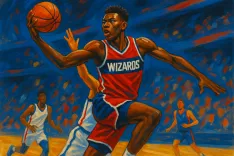

Utah Jazz Make a Bold Move with Darryn Peterson
The Utah Jazz have officially made a significant decision in the 2026 NBA Draft, selecting Darryn Peterson as the No. 2 overall pick. Coming off an impressive senior year in high school, Peterson entered the draft as the preseason favorite, but his journey took some unexpected turns after joining the Kansas Jayhawks. Despite facing challenges, Peterson has shown tremendous potential that the Jazz hope to tap into.
Highlight Reel: The Rise of Darryn Peterson
Darryn Peterson burst onto the scene during his final year of high school, where he demonstrated his scoring prowess and offensive versatility. This rise to prominence positioned him as the consensus top prospect leading into the 2026 NBA Draft. However, his transition to college basketball saw his stock fluctuate due to various factors at Kansas.
Throughout the season, Peterson faced issues such as cramping, which led to missed games or limited playing time during crucial moments. This inconsistency raised questions about his durability and availability. Despite these challenges, he maintained an impressive average of 20.2 points per game, showcasing his scoring ability.
Impressive Combine Stats
Evaluators are keeping a close eye on Peterson’s physical metrics, with a height of 6'4.5 inches, a weight of 198.8 pounds, and a wingspan of 6'9.75 inches. At just 18 years old, he also demonstrated statistics of 4.4 rebounds, 1.7 assists, 0.5 blocks, and 1.5 steals per game, along with commendable shooting percentages (44.2% FG and 38.4% from three-point range).
Comparisons to Other NBA Stars
When analyzing Peterson's style of play, comparisons have been drawn between him and NBA star Anthony Edwards. Both players are known for their scoring ability and their knack for creating their own shots. Much like Edwards, Peterson can generate offense in isolation as well as from ball screens, comfortably moving off the ball, shooting efficiently from spot-ups and during dribble handoffs.
This ability is crucial for a guard in the modern NBA, where offensive versatility is imperative. Peterson's talent as a scoring 2-guard makes him a valuable asset for any team looking to bolster its perimeter scoring.
Strengths of Darryn Peterson
One of Peterson's significant strengths lies in his off-ball scoring. Statistics indicate that he was among the country’s most efficient spot-up scorers during his time at Kansas, with a striking 47.1% success rate on dribble handoff threes. His ability to slash past closeouts and make timely cuts into the lane made him a consistent offensive threat.
Moreover, Peterson's knack for creation stands out. His ball-handling skills and change-of-pace ability allow him to navigate defenses and separate himself from opponents effectively. The Jazz are banking on the potential that he can evolve into a high-level ball-screen scorer.
Defensively, Peterson's playmaking ability shines brightly. With quick foot speed and impressive leaping ability, he creates opportunities for steals and blocks. In his final game at Kansas, he showcased this skill set by blocking four shots, indicating his potential to disrupt opposing offenses.
Areas for Improvement
Despite these strengths, Peterson has areas that require development. One glaring issue is his finishing at the rim. With only a 51.9% layup conversion rate, questions arise regarding his ability to convert around the basket. Furthermore, he only averaged 72 field-goal attempts in the paint across 24 games, raising concerns about his aggression in attacking the rim.
His playmaking skills are also under scrutiny. Peterson averaged just 1.6 assists to 1.6 turnovers, which raises red flags for scouts. While defenses might have exploited him with double teams, there were few instances of him utilizing his gravity to facilitate for others. Consequently, this lack of evidence on tape brings some uncertainty to how well he can manage playmaking duties in the NBA.
Finally, his off-ball defense poses another concern. Though capable of making plays on the ball, there were recurring instances where he made incorrect reads while out of position. This inconsistency may affect his overall defensive performance in the professional spectrum.
The Need for Development
The selection of Darryn Peterson by the Utah Jazz symbolizes the organization's commitment to investing in young talent with potential. The next steps for Peterson will be crucial as he transitions into the NBA. A solid training program focusing on strength building and developing his playmaking ability could help him rise to his full potential.
As the Jazz aim to enhance their roster, Peterson embodies the hope and excitement of a new chapter. With his skills and adaptability, Darryn Peterson could be a key player for the Utah Jazz for years to come.