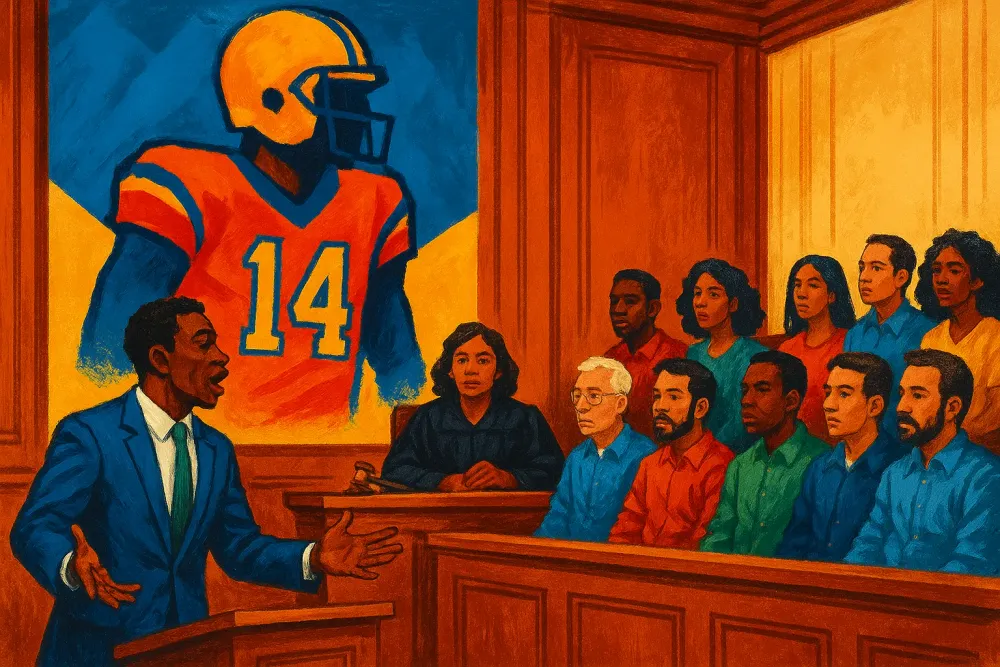
BOSTON (AP) — The highly publicized assault trial of former New England Patriots receiver Stefon Diggs took a crucial turn on Tuesday as closing arguments began. The courtroom was buzzing after both the prosecution and defense wrapped up their witness testimonies on what has been a contentious second day. The case revolves around serious allegations made by Jamila "Mila" Adams, who worked as Diggs' live-in personal chef.
During the trial, Adams recounted an alarming encounter that took place on December 2, claiming that Diggs came into her room following a text message argument. Tearfully, she testified that he "smacked me with an open hand" before allegedly wrapping his arm around her neck and choking her, which left her gasping for air. The nature of their relationship, she reiterated, was "complicated" — previously sexual but reportedly not so at the time of the alleged incident.
The Defense's Stance
Diggs' legal team has firmly denied Adams' accusations, asserting that the alleged assault never occurred. They argued that Adams has a vested interest in the case, pivoting the narrative to focus on financial disputes between her and Diggs. The defense pointed to claims of unpaid wages and rising payment demands as crucial evidence of her motivations. According to legal representatives, Adams initially demanded approximately $19,000, and this figure later ballooned to $5.5 million.
Throughout her testimony, Adams faced rigorous questioning from the defense, during which she often appeared evasive. At one moment, she stated that Diggs offered her $100,000 to retract her statement to the police, a claim that was later struck from the record after a sidebar discussion between the judge and attorneys. Judge Jeanmarie Carroll admonished her at times, instructing her to stick to direct answers and warning that continued evasiveness could jeopardize her statement's validity.
The Role of the Police Testimony
In this trial, the credibility of witness accounts, including those from law enforcement, emerged as a focal point. Kenneth Ellis, the Dedham police officer who recorded Adams' initial report, testified that she appeared visibly upset upon arriving at the station, describing her as crying and needing time before she agreed to give a statement. However, when pressed, Ellis acknowledged that he did not document any visible injuries on Adams or collect photographs to substantiate her claims, suggesting that his investigation heavily relied on her assertions and accompanying text messages.
Counteracting Adams' Claims
The defense called upon various witnesses from Diggs' circle to provide counter-narratives to Adams' testimony. His chief of staff, massage therapist, and hairstylist all chimed in, stating they interacted with Adams within days following the alleged assault and reported seeing no visible marks or injuries. Xia Charles, Diggs' hairstylist, testified that during their time together in New York post-incident, Adams appeared normal and showed no signs of distress or injury.
Additionally, jurors were shown cellphone videos of Adams in social settings, reportedly enjoying life and socializing shortly after the alleged events, which the defense suggested undermined her claims of trauma.
Prosecution's Argument
Despite the defense's attempts to present Adams as unreliable, the prosecution reiterated that the core of the case remains a criminal allegation. They suggested that the testimonies offered by Diggs' associates could be influenced by their relationships with the NFL star, implying that their careers depend on an outcome favorable to him.
This dynamic highlights the complexity of relationships intertwined with power, money, and professional ties, particularly in high-stakes environments like that of a NFL star. The prosecution's narrative suggests that while financial disputes may exist, they don't diminish the gravity of the assault allegations.
What Lies Ahead
As the trial progresses, both sides remain poised for the jury's decision that could alter the course of Diggs' life and career. The stakes are high. Diggs faces serious legal ramifications, including a felony strangulation charge and a misdemeanor assault and battery charge related to the December incident.
With closing arguments presented, the jury is now tasked with sifting through the evidence and testimonies presented throughout the trial. The outcome will not only impact the lives of those involved but could also have reverberating effects on the reputation and future of the NFL player.