
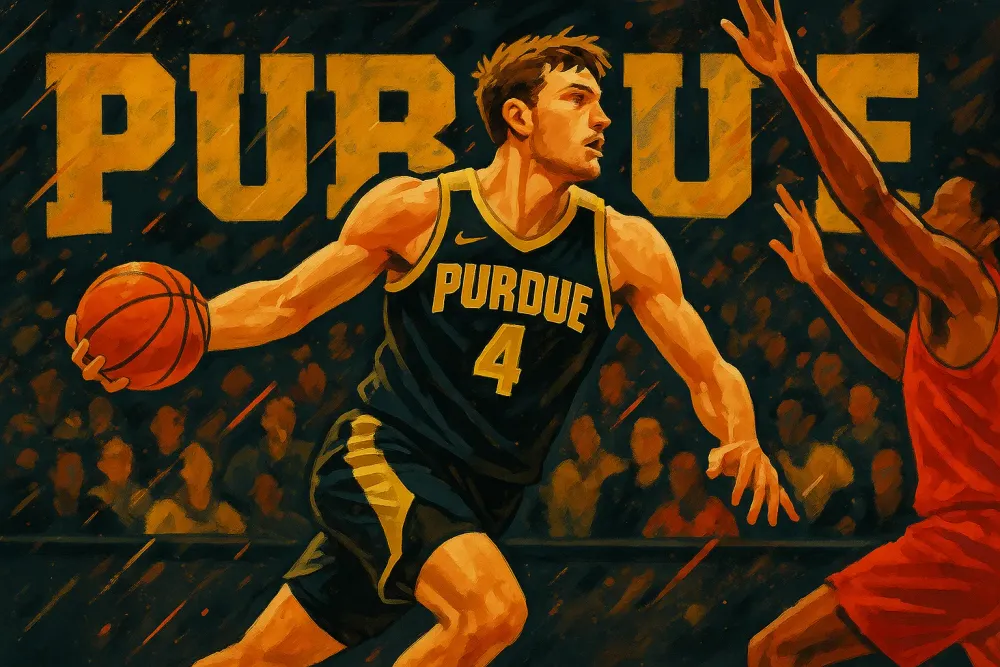
As the landscape of college athletics continues to evolve, the case of Trey Kaufman-Renn has highlighted ongoing challenges surrounding player eligibility and the intersection of collegiate sports with the professional arena. The former Purdue Boilermakers standout and recent NBA draft pick has secured a temporary restraining order against the NCAA, paving the way for a potential sixth year of eligibility in college basketball.
The ruling, reported by Nathan Baird of the Indianapolis Star, means that Kaufman-Renn's eligibility cannot be denied based on his previous five years in college or his professional status after being selected with the No. 59 overall pick by the Minnesota Timberwolves in the June NBA draft. This decision comes after Kaufman-Renn filed a lawsuit arguing for additional college eligibility this past August.
A Closer Look at Kaufman-Renn’s Journey
Kaufman-Renn's collegiate journey began when he joined the Purdue Boilermakers for the 2021-22 season. However, he encountered an unusual setback as he redshirted his initial year, which kept him off the court during what would have been his true freshman season. Over the subsequent four years, he accumulated significant experience, playing in 147 games and making a notable impact in the Big Ten.
During his junior season in 2024-25, Kaufman-Renn earned All-Big Ten first team honors, a testament to his hard work and dedication on the court. Over his four seasons at Purdue, he averaged an impressive 11.3 points and 5.2 rebounds per game, showcasing his skill set that ultimately attracted the attention of NBA scouts.
The Legal Battle for Eligibility
Kaufman-Renn's argument hinges on the NCAA's age-based eligibility rule, which stipulates that student-athletes can compete for up to five years provided they enroll in college before the academic year after their 19th birthday. The crux of his lawsuit suggests that had the rule been in effect at the time of his enrollment, he would not have had to sit out his first year at Purdue, consequently impacting his overall college basketball experience.
The granting of a temporary restraining order signals a significant moment in this ongoing legal battle, affirming Kaufman-Renn’s right to pursue further participation in college basketball if he is cleared during the forthcoming legal proceedings. As Baird notes, there is currently no set date for a preliminary injunction hearing, adding uncertainty about the timeline for Kaufman-Renn's next steps.
Kaufman-Renn’s Future Prospects
Following the judge's recent ruling, Kaufman-Renn took to social media expressing his sentiments about his time at Purdue. He stated that his tenure with the Boilermakers has “come to an end,” but his excitement for the future is palpable. The big question remains: where will Kaufman-Renn lace up his sneakers for the 2026-27 season? As he contemplates his next move, the doors to opportunities across collegiate programs may now open wide, provided he is granted the eligibility he seeks.
This ongoing situation not only sheds light on Kaufman-Renn’s career trajectory but also raises broader questions about the NCAA’s rules governing eligibility and the evolving landscape of college athletics. As more players explore professional options while considering the chance for additional college experience, it could instigate a reevaluation of existing policies.
The Impact on College Sports
The case of Kaufman-Renn is emblematic of a shifting narrative in college sports, one where professional pursuits intermingle with the traditional path of NCAA competition. His situation reflects the complexities athletes face as they transition from amateur status to professional play, and the implications this has on their ability to return to the college arena.
As college football grapples with similar challenges regarding eligibility and returning players, Kaufman-Renn’s fight serves as a potential blueprint for others in the same predicament. It emphasizes the crucial role of legal advocacy in helping student-athletes navigate the fabric of collegiate sports that is often marred by intricate rules and regulations.
Overall, the outcome of Kaufman-Renn’s legal battle could have lasting repercussions, not just for him but for many athletes aspiring to maximize their playing careers in both collegiate and professional arenas.