Struggles for the Timberwolves
The Minnesota Timberwolves have made remarkable strides in the NBA over the past three seasons, successfully clinching five playoff series and reaching the Western Conference Finals twice. However, despite these achievements, the team appears to be drifting away from true competitive relevance. With the San Antonio Spurs and Oklahoma City Thunder elevating their game to new heights, Minnesota faces the daunting task of regrouping, retooling, and reloading if they hope to reclaim their position among the league's elite.
An Offense in Need of Revitalization
One of the critical areas that require attention for the Timberwolves is their offense, which has become overly reliant on young star Anthony Edwards. Minnesota's postseason offensive rating stood at a dismal 108.1, the lowest among all teams that participated in at least ten playoff games. This statistic underscores the idea that the Wolves' offensive strategy is woefully inadequate when measured against the depth and sophistication of other postseason contenders.
Defensive schemes have proven largely effective against Minnesota, largely because opposing teams are able to focus on neutralizing Edwards without the fear of being punished for collapsing on him. The burden on Edwards is excessive, and the need for a reliable secondary creator in the lineup has never been more critical.
The Search for a Solution: Kyrie Irving
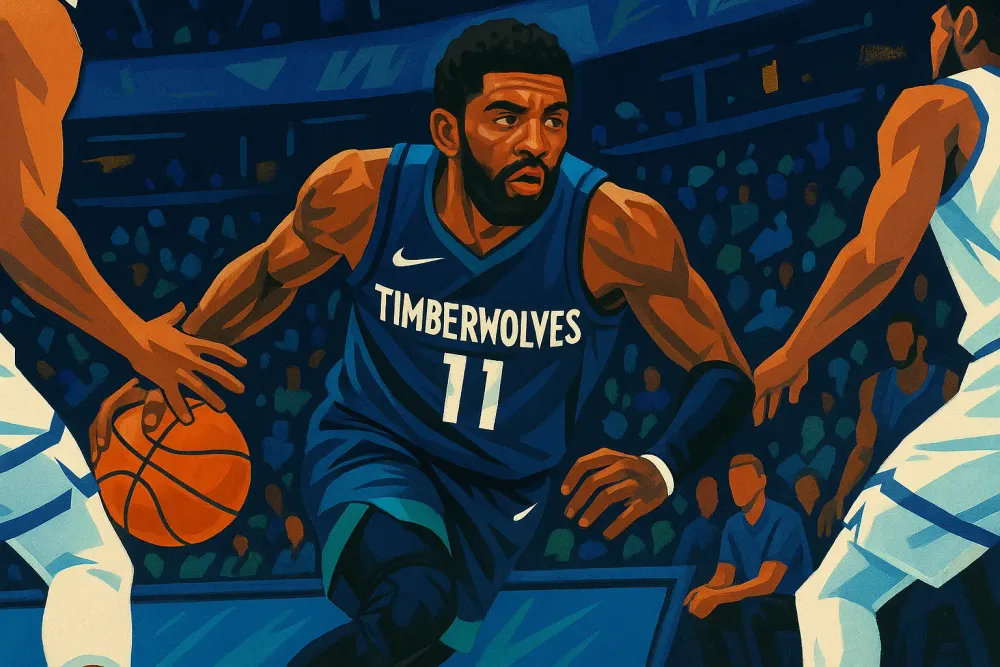
In the midst of these challenges, reports are circulating that the Timberwolves are setting their sights on nine-time NBA All-Star Kyrie Irving as a potential addition to their roster. Despite coming off a season marred by a torn ACL, Irving remains one of the league's most dynamic offensive players. In the 2024-25 season, he averaged an impressive 24.7 points and 4.6 assists, boasting shooting percentages of 47.3% from the field, 40.1% from three-point range, and a remarkable 91.6% from the free-throw line.
Irving's addition could bring the offensive diversity that Minnesota urgently needs. If healthy, he would not only alleviate pressure from Edwards but also offer the Timberwolves an option to pivot their offensive strategies and command respect from opposing defenses. Having a player of Irving's caliber could fundamentally alter how teams approach their game plan against Minnesota, allowing the Wolves to explore new offensive dynamics.
A Calculated Risk
The potential acquisition of Irving is not without its concerns, as the Timberwolves must weigh the associated risks. The most significant factor is Irving's durability; he has struggled with injuries in the past and hasn't seen floor action since March 2025. There's also the question of contract implications, as Irving is signed through the 2026-27 season for $39.5 million, with a player option for $42.4 million for the following year. Minnesota is acutely aware of these financial commitments, especially since they aim to ensure they aren’t just swapping one problem for another.
Comparing Deals: What Each Team Stands to Gain
Reports suggest that a prospective trade could involve Minnesota sending Julius Randle, Donte DiVincenzo, and a collection of first-round picks to the Dallas Mavericks in exchange for Irving. This deal would see the Timberwolves parting with a draft pick from 2026, a swap in 2030, and another lottery-protected pick due in 2033, which signals the lengths to which they are willing to go to revamp their roster.
Randle's contributions as a secondary creator have not been consistent, and the team would benefit from shedding this burden. While DiVincenzo showed promise, his season ended prematurely due to a torn Achilles, and his impact was not sufficient to overcome Minnesota's overall struggles in the playoffs. Trading these players offers a potential reset for both Minnesota and Dallas, allowing the latter to gather assets that can aid in their rebuilding process.
Future Considerations for Both Teams
For the Mavericks, the decision to trade away Irving's contract comes down to risk management. By dealing him now, they can mitigate the uncertainties of his future performance and health while gathering valuable draft assets. Dallas is already navigating a tricky situation concerning their first-round picks—ownership tied to Charlotte and a lack of flexibility going into the upcoming seasons. Therefore, this trade could provide a necessary buffer for the Mavericks as they adapt to new leadership under President Masai Ujiri.
Ultimately, Minnesota’s gamble on Irving could either be a pivotal turning point for a franchise desperate to rediscover its competitive spirit or a miscalculated risk that leaves them farther away from contention. The stakes are high, and how both teams navigate this potential deal will undoubtedly shape the future of their respective franchises.
A New Dawn for the Timberwolves?
If the trade materializes, Minnesota could find themselves not only rejuvenated but also with a better structure to support Edwards. While the risk associated with Irving remains a crucial consideration, the allure of adding a player with championship experience and elite scoring capabilities is too powerful for the Timberwolves to ignore. As they continue to tinker with their roster and possible trade scenarios, only time will tell if this is indeed the right path for the franchise.