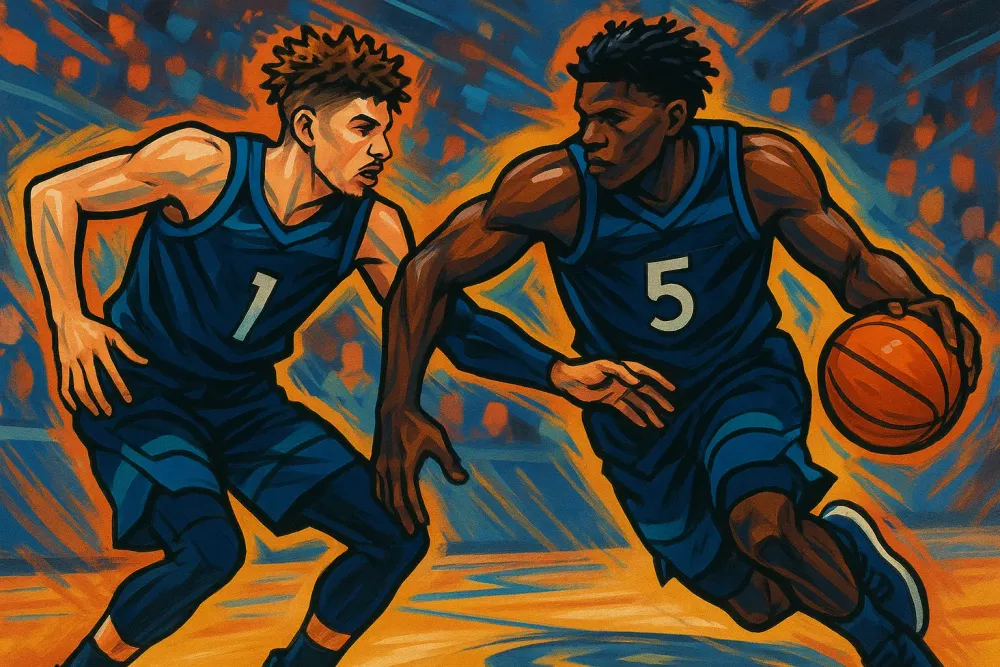
In a candid assessment of last season's struggles, Minnesota Timberwolves head coach Chris Finch acknowledged that the team's decision to leverage Anthony Edwards as a point guard may not have been the best move. This revelation comes as the organization prepares for a significant trade acquisition this summer: LaMelo Ball. Addressing the issue on the popular podcast, the Road Trippin' Show, Finch reflected on the challenges faced by Edwards during the 2025-26 season, particularly in the playoffs.
Unpacking Edwards' Role
Finch emphasized that the approach taken with Edwards did not serve him well. "We probably did Anthony a disservice last year, at times, playing him as a point guard," he stated. The coach went on to clarify how this reliance on Edwards backfired during critical moments in the playoffs when rival teams adapted by double-teaming him. Despite putting forth an exceptional statistical season, averaging career-highs of 28.8 points per game and a shooting percentage of 48.9, Edwards faced relentless defensive strategies that ultimately hindered the team’s performance.
In these high-pressure playoff situations, Finch noted that they failed to create enough opportunities for Edwards to thrive off the ball, particularly in terms of catch-and-shoot three-pointers. “We didn't create enough catch-and-shoot threes for him,” Finch lamented. This lack of offensive support proved detrimental during their six-game series elimination at the hands of the San Antonio Spurs.
The Impact of LaMelo Ball
With LaMelo Ball now on board, the Timberwolves organization hopes to alleviate some of that pressure from Edwards. Finch explained the impressive capabilities that Ball brings to the roster, particularly his playmaking prowess, with an average of 7.3 assists per game over his career. The statistics illustrate the potential upside of Ball’s arrival, as teammates seem to flourish in his presence. For example, Kon Knueppel shot seven percent better from beyond the arc when Ball was on the court compared to when he wasn’t, which Finch highlighted as a remarkable indicator of Ball's positive impact on offensive efficiency.
Furthermore, Ball’s track record shows promise; last season, he averaged 20.1 points and 7.1 assists while shooting 36.8 percent from three-point range. Although his injury history raises concerns, his ability to maintain durability, having played 72 games last season, suggests he can be a consistent presence on the floor. Finch believes Ball is what the Timberwolves needed to enhance their guard play and, crucially, to be the connective tissue within the team’s offense.
Unleashing Rudy Gobert
Another intriguing aspect of Ball's integration into the team involves the potential to unlock center Rudy Gobert as more of a lob threat. Finch’s strategic playstyle aims to utilize Ball’s exceptional passing skills to create opportunities for Gobert, who has often been underutilized in this capacity. The combination of Ball's vision and Gobert's size could lead to a more dynamic offensive strategy and an increased scoring output.
The Supporting Cast and Future Potential
The Timberwolves are not starting from scratch; they boast a solid supporting cast around their core leaders. Jaden McDaniels, Ayo Dosunmu, and Donte DiVincenzo add depth and versatility that will be crucial as the team looks to advance deeper into the playoffs. The roster versatility allows Finch to experiment with different lineups and setups, optimizing for fit around Edwards, Ball, and Gobert's strengths.
The overall balance of the Timberwolves’ roster appears promising as they gear up for the upcoming season. Finch's hope is that Ball's playmaking abilities will take some pressure off Edwards, freeing him to perform at his best without the burden of primary ball-handling. The synergy between Edwards and Ball will be critical, as they'll need to develop chemistry both on and off the court to maximize their collective impact.
Looking Ahead
The Timberwolves find themselves in a position of anticipation as they prepare for a modified approach to the game. While the trade for LaMelo Ball signifies a crucial change, it also reflects a deeper understanding of what adjustments are needed moving forward. As the new season approaches, all eyes will be on how well Edwards and Ball complement each other, potentially reshaping the Timberwolves' identity and ambitions in pursuit of a championship run.