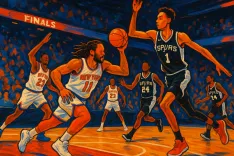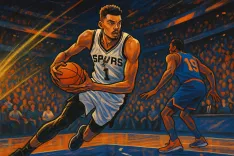

The San Antonio Spurs entered the NBA Finals looking to establish their dominance against the New York Knicks. However, a disappointing offensive performance in Game 1 resulted in a 105-95 loss, leaving them on the brink of a challenging series. To avoid dropping to 0-2 before heading to Madison Square Garden, the Spurs must focus on critical adjustments to their offensive strategies.
Strong Defense, Weak Offense
While the Spurs exhibited commendable defensive efforts, limiting the Knicks to a 109.4 offensive rating and an even lower 89.7 in halfcourt situations—both metrics marking New York’s second-worst performances during their impressive 12-game winning streak—their offense fell flat. It is evident that San Antonio's path to victory hinges on finding their scoring rhythm against a resolute Knicks defense.
Wembanyama's Screening Dilemma
Victor Wembanyama, arguably one of the best players in the league, showed glimpses of brilliance in Game 1. However, his performance was marred by ineffective screens that time and again failed to create opportunities for his teammates. The numbers suggest that the Spurs have solid screening capabilities, averaging 1.12 points per play involving the roll man during the playoffs. Yet, when Wembanyama set screens, their efficiency skyrocketed to 1.27 points per play. The disparity between expectations and reality raises concerns about Wembanyama's screening execution.
Too often, Wembanyama exited screen plays prematurely, in search of a quick catch, leading to ineffective plays that hurt the Spurs' offensive flow. Moreover, his attempts at physical screens often backfired, such as when Jalen Brunson skillfully drew an offensive foul. For San Antonio to enhance their half-court attacks, Wembanyama must improve his positioning. By allowing his guards to attack their defenders and facilitating screens that leave him open for passes, they can maximize scoring opportunities.
Targeting Brunson: An Opportunity
As the Spurs navigate their offensive struggles, prioritizing matchups becomes critical. The Knicks' Jalen Brunson has been a pivotal figure, particularly evident in Game 1, where he scored 13 points in the final minutes, outpacing the Spurs' effort. San Antonio cannot afford to ignore targeting Brunson defensively, ensuring their best perimeter scorers face him frequently.
Despite Brunson’s impressive capabilities, he remains a defensively exploitable player, particularly in high pick-and-roll scenarios. The Spurs should strategize to draw Brunson into the action, allowing their perimeter threats opportunities to thrive against the Knicks' weak links. Such an approach may enhance scoring chances, especially against New York’s defense, where a more tactful game plan could yield dividends.
Emphasizing Transition Plays
Moving the ball quickly in transition has proven effective for the Spurs, as evidenced by their 25 transition points scored in the first half of Game 1, averaging an impressive 1.47 points per transition play. In contrast, their production dwindled after halftime, only managing four transition points while scoring a paltry 0.29 points per transition play. The Knicks’ ability to limit turnovers also hampered San Antonio’s fast-break opportunities, but the Spurs must remain committed to running off defensive rebounds and even their makes to capitalize on New York's transitioning defense.
Wembanyama's Offensive Adjustments
A significant aspect of the Spurs' strategy must include leveraging Wembanyama's talent effectively. The Knicks have already adapted to preventing him from receiving passes in the restricted area, thus limiting his scoring potential. For the Spurs to counter this, Wembanyama should concentrate on attacking the rim decisively while also being open to stepping out for three-point opportunities. By developing a more versatile scoring arsenal, including taking timely threes, he may draw defenders out of the paint, creating avenues for fellow teammates.
De'Aaron Fox: A Questionable Presence
Another complication for San Antonio has been De'Aaron Fox, whose ability to create shots has dramatically waned due to an ongoing high ankle sprain. While Fox’s veteran experience and leadership are undeniable, the injury has severely hindered his performance. In Game 1, he managed only 3-of-13 shooting, raising questions about his effectiveness on the court compared to Dylan Harper, who excelled in his minutes, pushing the pace and putting pressure on the Knicks' defense.
The Spurs must evaluate their strategic reliance on Fox. While he provides valuable leadership, the stats indicate that he is not in the best physical shape to impact the game like he once did. In contrast, Harper's ability to create offensive pressure suggests that a tactical shift might be beneficial, particularly if it leads to stronger engagement from the San Antonio offense.
Path Forward for the Spurs
For the San Antonio Spurs to climb back into this series, they need to make some critical adjustments. Their defensive capabilities are strong, but they must enhance their offensive strategies to secure scoring against New York's resolute defense. Improving Wembanyama's screening, focusing on using transition opportunities, and evaluating Fox’s role will collectively determine their success in upcoming games. Heading into Game 2, the Spurs are faced with significant challenges, but with the right adjustments, they can potentially turn the tide against the Knicks.