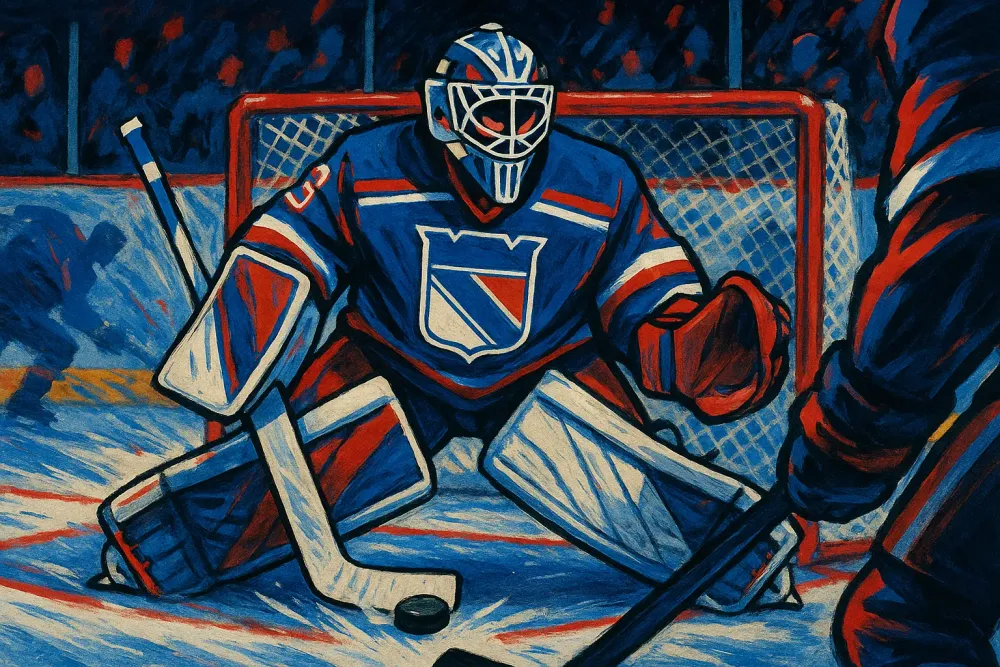
As the New York Rangers gear up for the 2026-27 NHL season, optimism was riding high after an effective offseason that effectively addressed critical roster issues, particularly in goal-scoring depth and bolstering their defense. However, that belief took a significant hit with the recent announcement that star goaltender Igor Shesterkin would miss the remainder of the season due to an injury sustained against the Washington Capitals. This cavernous gap in the Rangers' lineup not only impacts their immediate performance but also their playoff aspirations moving forward.
Shesterkin's Impact and His Absence
Igor Shesterkin has been a pillar for the Rangers since his arrival, consistently proving to be one of the elite goaltenders in the league. His ability to bail out a sometimes shaky defense has made him an integral part of the Rangers’ strategy, often serving as the linchpin in tight games. With a well-documented track record of excellent performance metrics, Shesterkin's departure from the lineup leaves the Rangers with a massive void to fill. Dylan Garand, a promising prospect who has shown promise this season, is expected to take over the starting role. However, the Rangers have built their strategy around their reliance on a top-tier goalie, making Garand’s task monumental given the lengthy and grueling hockey season ahead. As a team known for a goalie-dependent playstyle, the loss of Shesterkin significantly compromises the Rangers' chances of making a deep playoff run.
Evaluating Potential Trade Targets
With Shesterkin out for the season, the door has swung wide open for the Rangers to explore trading for a goaltender. The landscape is filled with potential options, each with their pros and cons. One name that has surfaced in discussions is Connor Hellebuyck of the Winnipeg Jets. Hellebuyck, a Hall of Fame-worthy goalie with multiple Vezina Trophies under his belt, would fit perfectly into the void left by Shesterkin. His ability to perform at an elite level, frequently ranking among the NHL’s top goaltenders, makes him a tantalizing trade target.
However, the practicality of bringing Hellebuyck to New York is dubious. For one, the Rangers are not currently positioned as immediate Stanley Cup contenders. Paying a hefty price for Hellebuyck would not only involve significant assets being shipped to Winnipeg but could result in a cumbersome salary cap situation—the combined contracts of both him and Shesterkin would soar above $20 million per year. With both goalies on long-term deals, their potential to co-exist in New York is anything but straightforward.
Alternatives and Stopgaps
In addition to Hellebuyck, other names have emerged on the Rangers' radar. Jordan Binnington of the St. Louis Blues is another potential target. However, with a record that has seen him struggle considerably over recent seasons, including a minus-9 goals saved above expected statistic, acquiring Binnington may not yield the desired results. The Rangers need a stabilizing presence in goal, and his past performance might not inspire confidence in a franchise looking to make a playoff push.
On a more favorable note, Philipp Grubauer of the Seattle Kraken presents a viable option. After a rough start with the Kraken, Grubauer appears to be regaining his rhythm and could offer the Rangers at least league-average play while keeping them competitive in the playoff race. Given his current status as a pending UFA, the Rangers might score a relatively inexpensive trade that could help make up for Shesterkin's absence.
Emergency Stopgaps: Darcy Kuemper and Anton Forsberg
The Los Angeles Kings are another team to watch, as they currently have two veteran goalies on expiring contracts: Darcy Kuemper and Anton Forsberg. While they both are off to slow starts this season, they could provide the Rangers with some much-needed experience if the franchise is hesitant to go full throttle with Garand and Spencer Martin until the return of Joonas Korpisalo. It would be worth investigating whether either goalie could outperform their current expectations as short-term solutions.
The Long-Term Picture
Moreover, the possibility of a three-team trade involving Hellebuyck, the Rangers, and another franchise like Utah adds another layer of complexity. If Hellebuyck moves to Utah, could the Jets then flip their current backup, Karel Vejmelka, to the Rangers as part of a separate deal? Although Vejmelka could offer help this season, acquiring him would mean a long-term cap commitment that might be unwise for the Rangers given Shesterkin is expected to return.
Ultimately, the Rangers are in a complex position following Shesterkin's injury. The pressures of the season loom large as they work to secure a replacement that aligns with both short-term competitiveness and long-term salary cap health. This pivotal decision window will significantly shape the outcome of their season aspirations.