
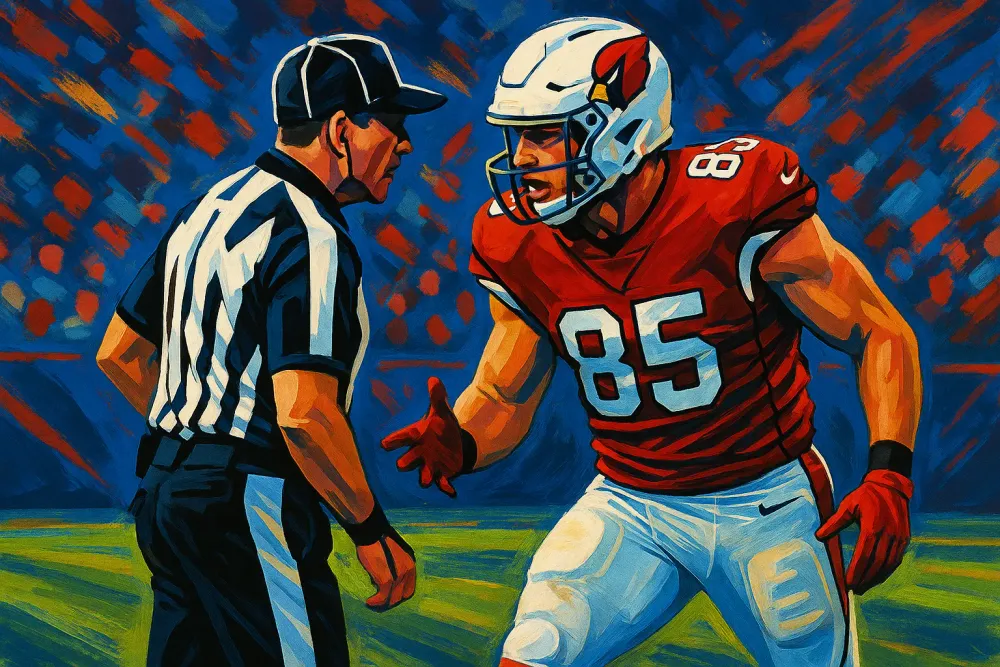
The NFL is currently investigating several incidents that occurred during Sunday's games, sparking discussions about the relationship between players and officials. Among the noteworthy exchanges was one involving Arizona Cardinals tight end Trey McBride and an official during the New York Giants' 36-24 victory over the Cardinals. Adam Schefter from ESPN reported on the league's investigation into this interaction, which has drawn criticism and raised questions on accountability within officiating.
Incidents Reported
In particular, the league is scrutinizing an exchange where referee Adrian Hill expressed visible anger towards Minnesota Vikings linebacker Eric Wilson, who inadvertently knocked him over. Such incidents are not new in the NFL, but the scrutiny they are receiving this week emphasizes a growing concern regarding the standards to which officials are held.
Trey McBride's Exchange
In the case of McBride, reports indicate that the young tight end approached the official politely, even incorporating the word “please” into his remarks. According to Schefter, the most pointed statement McBride made was, “You’re ruining the game,” a comment that underscored his frustration with the officiating. While perhaps not egregious, the phrase reflects a sentiment echoed by many players and fans alike regarding the need for fair and consistent officiating in games that have immense implications for teams.
Official's Accountability Called into Question
In response to the incident, NFL Players Association Executive Director JC Tretter took to social media to emphasize the need for accountability among officials. Tretter stated, "This kind of behavior from an official towards a player is unacceptable. Players are consistently held accountable when the roles are reversed. We expect the NFL to hold officials to the same standard." His comments add a layer of complexity to the ongoing dialogue about how players and officials interact during games and how both groups can be held accountable for their actions.
Vrabel's Unsportsmanlike Conduct Penalty
The altercations on Sunday were not limited to the Cardinals game. New England Patriots coach Mike Vrabel was also involved in a controversial moment, receiving an unsportsmanlike conduct penalty for his commentary during the game. Vrabel expressed his disbelief at the ruling, stating, "I told him it was a terrible—I'm not going to say effing—call. I've said that 87 times since I've been a head coach. It was nothing derogatory. You'd have to ask him. I think he was a little sensitive." These remarks highlight the constant tension in the league between maintaining respect for officials while also advocating for players and coaches’ frustrations.
The Broader Context of Official-Player Relations
The relationship between officials and players is often fraught, marked by high-pressure situations where split-second decisions can impact the game. While emotions can run high, these recent incidents appear to underscore an increasing intensity in exchanges that might be more representative of unease rather than typical game-day frustrations. Coaches and players alike are often in vulnerable positions, trying to navigate the rules while ensuring that their voice is heard.
Conclusions on Sunday’s Tensions
This season may become a pivotal point for how the NFL handles its officials and the interactions that arise during games. As technology and scrutiny from fans increase, the league finds itself at a crossroads: balancing effective officiating with the need to create a positive environment for players and coaches. How the NFL responds to these recent calls for accountability among officials will likely set a precedent for future interactions and could be a topic of discussion moving forward.
As investigations unfold, it is clear that more than just penalties may be on the line. The reputation and fairness of officiating in the NFL is under a microscope, and the outcome of these inquiries could reshape the dynamics of how games are officiated and how players express their grievances in real time.