
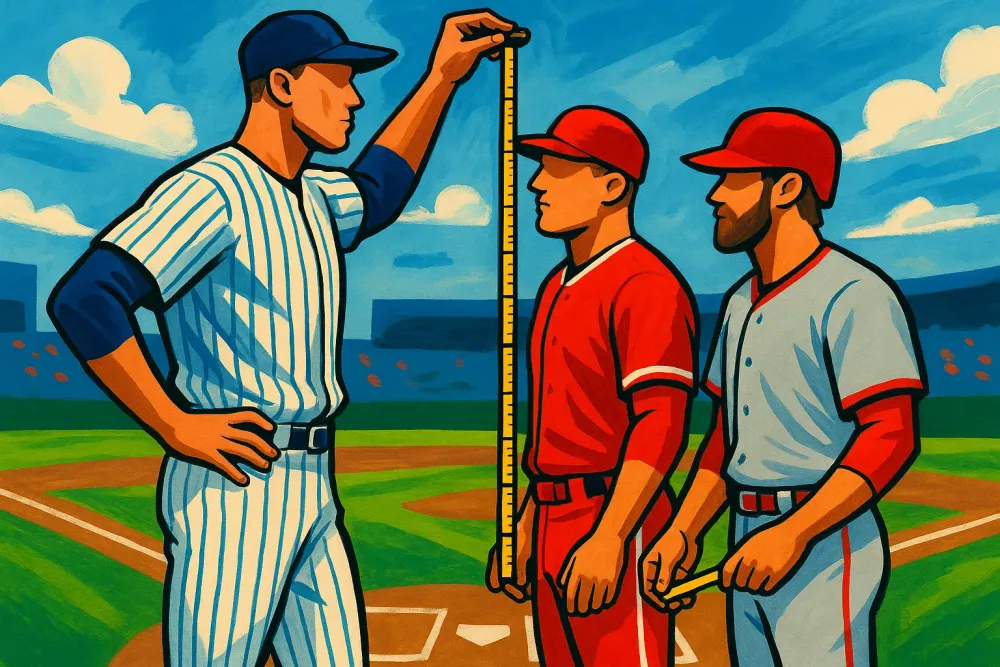
This season, Major League Baseball (MLB) has introduced the Automated Ball-Strike (ABS) pitch challenge system, resulting in significant changes in player heights across the league. With accuracy being the main focus of this initiative, a notable number of hitters have found their official heights reduced, marking a shift in how player statistics are recorded.
A Closer Look at the Changes
As reported by Sam Blum of The Athletic, 225 out of the 430 hitters listed on Opening Day rosters have seen their heights reduced compared to the previous two seasons. The data reveals a substantial re-evaluation of player measurements, with six players experiencing a significant drop of three inches, 48 players losing two inches, and 171 players seeing a reduction of one inch in their recorded heights.
In contrast, only 45 players gained up to one inch, and two players found themselves listed with an increase of two inches. Collectively, it has been estimated that MLB players have lost nearly 20 feet in height due to these adjustments, a figure equivalent to three full-sized individuals the height of New York Yankees star Aaron Judge, who stands tall at 6'7" and remains unaffected by the changes.
Impact on Player Statistics
The shift in height measurements is significant. Among those impacted, notable players such as Toronto Blue Jays first baseman Vladimir Guerrero Jr. and Los Angeles Angels outfielder Mike Trout have had their listed heights reduced. Philadelphia Phillies first baseman Bryce Harper and other prominent figures like Seattle Mariners catcher Cal Raleigh and New York Mets players Juan Soto and Francisco Lindor also saw declines.
Specifically, players now listed at 5'11" averaged a 0.82-inch reduction, making this newly common height the most frequently listed among hitters, with 74 players standing at this mark. Following closely, 72 hitters stand at exactly 6 feet tall, indicating a clear trend toward more accurate player measurements in MLB.
The Push for Perceived Height
Interestingly, this height discrepancy has shed light on the pressures players face regarding their official listings. Miguel Rojas, Los Angeles Dodgers shortstop and the hero of the 2025 World Series, shared his experiences with height measurement. He admitted to urging officials to record him as 6 feet tall, stating, "I always pressed the guys who did the measurement to leave me as 6 feet. Because I was like, 'I'm so close to being 6 feet. What can we do? What can we do to put me at 6 feet?' I think it's better optics." This notion speaks to the tendency within professional sports to inflate certain metrics for enhanced image and appeal.
The Role of the ABS Pitch Challenge System
The implementation of the ABS pitch challenge system has brought forth another layer to the discussion around accuracy in MLB. This technology allows teams to challenge balls and strikes for the first time in regular-season games, enhancing the integrity of umpiring decisions. Each team commences a game with two challenges, maintaining these chances as long as they continue winning their appeals. However, should a team lose two challenges, they forfeit the ability to contest any further calls in that game.
According to Baseball Savant, a striking 54 percent of ABS challenges have resulted in calls being overturned since the system’s inception, indicating its impact on gameplay and officiating. This accuracy-focused approach aligns with the league's efforts to ensure that player statistics, including height, reflect reality more faithfully.
Conclusion
The adjustments made to player heights in the MLB are emblematic of a broader effort to prioritize accuracy across the league's statistical measures. With the introduction of the ABS pitch challenge system, players and teams alike are navigating a new paradigm that embraces a more genuine representation of athlete metrics. As the season progresses, it will be intriguing to observe how these changes influence player performances, team strategies, and the continuation of accurate record-keeping in America's favorite pastime.