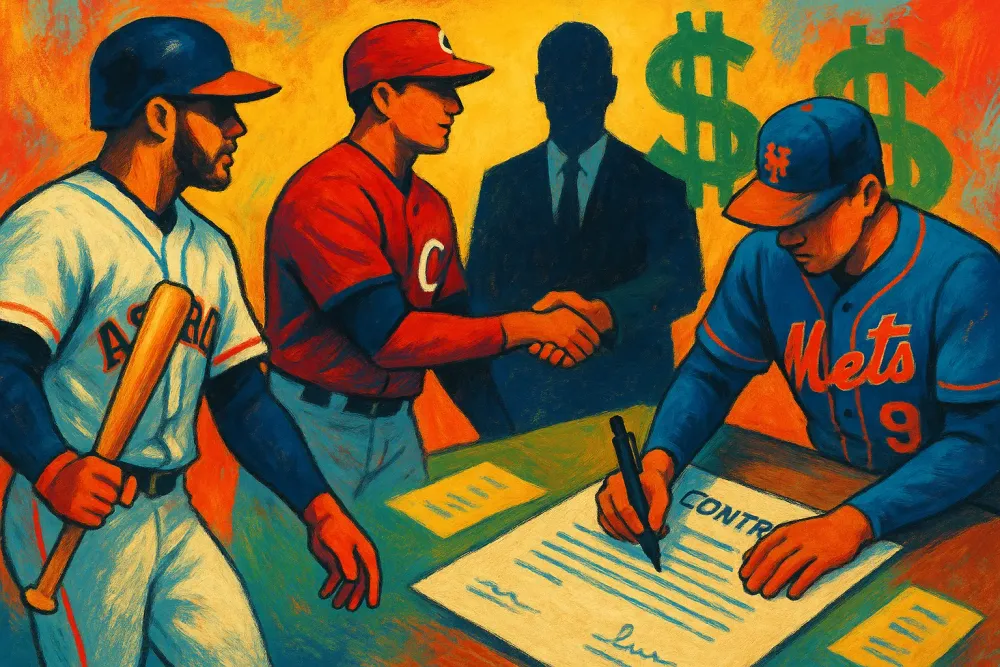
As Major League Baseball (MLB) and the MLB Players Association (MLBPA) prepare for what could be a contentious labor dispute, both sides are gearing up for discussions that may reshape the financial landscape of the sport. Among the key topics on the table is the possibility of instituting a salary cap in the next collective bargaining agreement (CBA). This proposal, if realized, would mark a significant shift in how teams manage their payrolls.
Current Negotiations and Proposals
Recent reports by Evan Drellich of The Athletic indicate that MLB owners are formulating a proposal that includes a potential salary cap, with a suggested structure of a $160 million salary floor and a $240 million ceiling. This proposal reflects an attempt by the league to level the playing field between teams with varying financial capabilities.
A management source explained that the richest teams, which include the Los Angeles Dodgers, New York Mets, and New York Yankees, might actually favor a cap on spending. With the Dodgers holding a league-high payroll of $402 million, a salary ceiling could alleviate pressure from fans for extravagant spending on player contracts. Such a change would also push smaller market teams, who often cannot afford large payrolls, to increase their expenditures in order to remain competitive.
Implications for Team Spending
The proposed salary cap would drastically influence team dynamics within the league. According to the management source, the major markets would stand to benefit significantly from such a limitation, as they would no longer be pressurized to inflate their payrolls to exorbitant levels. The plan may include removal of the “arms race” mentality that has been prevalent in the league's financial dealings.
Should the owners successfully lobby for a salary cap, teams would face new restrictions regarding contract lengths and values. The current system in MLB allows for players to enter into extended agreements, with 33 players signed to contracts exceeding eight years, including Juan Soto's impressive 15-year, $765 million deal with the New York Mets.
The Hard-Cap Model Comparison
One of the alternatives being considered is a hard-cap system similar to that employed by the National Hockey League (NHL). Unlike the NBA's flexible cap system, a hard-cap would impose stricter limitations on both the length and financial value of player contracts. This could lead to a more balanced competition as teams navigate their strategy under new constraints.
The NHL system, for instance, allows teams to offer contracts up to seven years long for players re-signing with their existing clubs and six years with new teams. The adoption of a similar model could significantly alter the landscape of player movement and team composition in MLB.
Looming Labor Stoppage and Management's Strategy
As of now, deep negotiations between MLB and the MLBPA have yet to commence. Recent discussions between the two were preliminary and took place in November, leaving many questions surrounding the future of the league's labor relations. Notably, the current CBA is set to expire on December 1 and if the two sides cannot reach an agreement, a labor stoppage seems inevitable.
The prospect of a labor stoppage is concerning, especially considering MLB has not lost regular-season games to a work stoppage since the infamous 1994 strike, which extended until April 1995. The potential for games being canceled if discussions stall into the critical spring training period of February or March 2027 looms heavily over the sport.
Conclusion
The impending labor discussions in Major League Baseball present both challenges and opportunities for teams, players, and fans alike. With a salary cap proposal on the horizon, the stakes are higher than ever. The potential for a labor dispute raises concerns over the start of the next season, making it imperative for both sides to engage in productive dialogue to avoid repeating the mistakes of the past. As discussions progress, all eyes will remain on how the MLB and its players navigate this critical juncture in the sport's history.