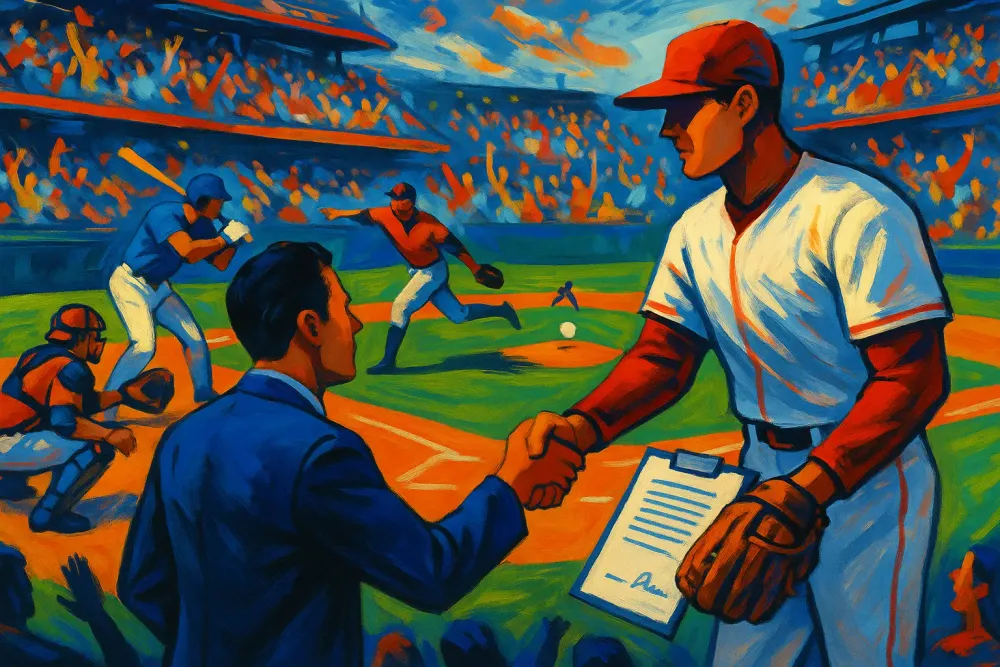
Major League Baseball (MLB) is witnessing a significant transformation in its free agency landscape, leading many to question the vitality of the system that for decades has helped shape the game's competitive balance. The last few seasons have highlighted just how pivotal free agency has been in determining the outcome of the World Series, yet recent trends suggest that the free-agent market may be facing unprecedented challenges.
A Shift in Dynamics
Reflecting on recent history, the last three World Series champions have substantially benefited from key free-agent signings. Notable names such as Aaron Judge, Shohei Ohtani, and Juan Soto have not only set benchmarks for the highest contracts in MLB history but have also shaped how franchises approach building their rosters. However, in a climate that has seen these contracts reset the expectations for player salaries, there are signs that free agency is moving towards a less favorable era.
The Impact of a Cooling Market
The stark contrast of the 2025-26 offseason reveals the plummeting enthusiasm surrounding free agency. Recent statistics from FanGraphs indicate that the spending for this offseason was under $3 billion, the first decline in five years. Teams are starting to show wariness towards long-term investments, particularly in players who don't meet crucial criteria: youth and superstar status. This caution isn't unfounded; the previous winter showcased an alarming trend where marquee signings failed to deliver on expectations.
Analyzing Recent Signings
Players like Kyle Tucker and Bo Bichette were expected to drive the market but ultimately fell short of their projected value. Despite expectations of lucrative contracts, they produced disappointing results, averaging merely 0.7 fWAR among the top 20 signings. In the grand scheme of things, only six contracts managed to reach the baseline threshold of 1.0 fWAR. In stark contrast, numerous other players surpassed this figure, emphasizing the imbalance in recent signings.
The Future Looks Bleak
The outlook for free agency appears grim, particularly with a weak crop of potential free agents emerging. The most notable name is two-time Cy Young Award winner Tarik Skubal, whose recent elbow issues raise concerns regarding his durability and long-term value. Coupled with aging pitchers such as Kevin Gausman and underwhelming seasons for several stars, the chances of seeing blockbuster contracts diminish significantly. The current crop lacks the firepower previously witnessed, making it unlikely that these players will command the nine-figure deals expected in seasons past.
Concerns Over Potential Work Stoppage
The specter of a work stoppage looms large as MLB's collective bargaining agreement (CBA) negotiations approach. Unlike the previous lockout that occurred over the 2021-22 offseason, which did not significantly hinder the flow of money into the free-agent market, this situation feels distinct. Owners appear determined to implement measures that could restrain spending, potentially crippling the free-agent landscape and limiting opportunities for players looking for lucrative contracts.
Changing Attitudes Towards Free Agency
Another trend emerging from this changing market dynamics is the growing preference for contract extensions over free agency. The Toronto Blue Jays' decision to secure Vladimir Guerrero Jr. with a colossal 14-year, $500 million extension underlines this shift. Had Guerrero entered the free-agent market following a high-profile playoff performance, the bidding war could have vastly reshaped the landscape. This sentiment reverberates throughout the league, with stars like Ronald Acuña Jr. and Yordan Alvarez choosing stability and security through early extensions rather than waiting for free agency.
The New Norm: Early Extensions
Recent trends show a marked shift toward players signing away free-agent eligibility much sooner than in years past. Young talents rushing to lock in lucrative pre-free agency deals further signify the changing climate in MLB. The lure of immediate financial security often proves too strong for upcoming stars to resist, raising questions about the long-term implications for the free agency system.
Reflecting on the Future of Free Agency
If present patterns continue, the free-agent market may gradually lose the vibrant competitiveness that characterized it in previous decades. While it is unlikely that free agency will vanish overnight, ongoing trends indicate it could erode quietly but steadily. Understanding the underlying motivations for early contracts and the resultant pressures on front offices and players alike can shed light on this evolving landscape.
As MLB navigates through these tumultuous waters, the implications of such changes will resonate throughout the league. Free agency has always served as a vehicle for emergence, allowing players to capitalize on their accomplishments. Nevertheless, the current direction suggests that free agency may not hold the same allure as it once did—an evolution that could redefine the fabric of player movement and compensation in Major League Baseball.