
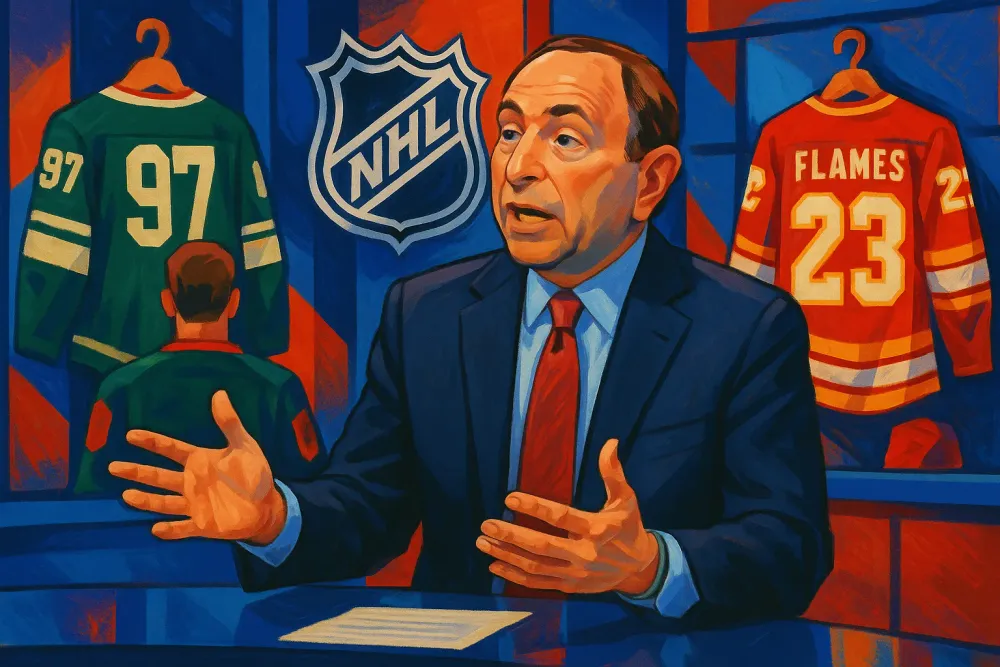
NHL Commissioner Gary Bettman is voicing his discontent over how players are leveraging no-trade and no-movement clauses to facilitate trades, arguing that this trend poses challenges not just for teams, but also for the league and its fans. Speaking on the FAN Hockey Show, Bettman shared his perspective that the current state of player movement is not ideal, expressing concerns about the implications for the sport.
The Context of No-Trade Clauses
No-trade clauses (NTCs) and no-movement clauses (NMCs) have become increasingly prevalent in the NHL, providing players with significant control over their careers. These provisions allow players to dictate where they can or cannot be traded, directly impacting team strategy and the dynamics within a dressing room.
Examples of Recent Player Actions
Bettman's remarks follow specific instances noted by ESPN's Greg Wyshynski where players have utilized these clauses to their advantage. Notably, Ottawa Senators captain Brady Tkachuk recently exercised his NMC, allowing him to move to the Florida Panthers, where he can join his brother, Matthew Tkachuk. On the other hand, Columbus Blue Jackets defenseman Zach Werenski blocked a trade to the Dallas Stars, despite indicating he did not plan to re-sign with the Blue Jackets when his contract concludes in 2028.
Detroit Red Wings center Dylan Larkin is another player in the spotlight, as he harbors intentions for a trade, but initially limited his options to a select few teams including the Minnesota Wild, Vegas Golden Knights, and Florida Panthers. Now, his list has expanded to include the Colorado Avalanche, Washington Capitals, Dallas Stars, and Tampa Bay Lightning, providing a wider range of potential destinations.
Winnipeg Jets goalie Connor Hellebuyck also stirred headlines by issuing a trade request and opting not to report to training camp, further exemplifying how players are exercising their power in trade negotiations.
Bettman's Concerns
Bettman articulated his concerns: "As I look at what's happened or is happening now, I don't think that's a good thing. I don't think it's good for the player, I don't think it's good for the club, I don't think it's good for fans watching and their connection to the game." He emphasized that players should not have the unilateral power to choose their destinations or request trades. Bettman hinted that if the trend continues to develop, it might necessitate a discussion with the NHL Players' Association (NHLPA).
The Future of Player Contracts
Allan Walsh, an NHL agent, responded to Bettman's comments, pushing back against the notion that the current system is detrimental to the league. With the current collective bargaining agreement (CBA) set to run through the 2029-30 season, Walsh suggested that changing these contracts may not be an immediate concern but could be revisited during future negotiations. This opens the door for potential alterations that could redefine the balance of power between players and teams.
Implications for the League and Players
The situation has placed the futures of several high-profile players in a state of uncertainty as the new NHL season unfolds. The ongoing debate around player empowerment versus organizational control raises critical questions about the evolution of player contracts and their impact on team dynamics.
As Bettman stated, "If this becomes a problem... it's something we're going to have to discuss with the players' association." Though he acknowledged that not every offseason may present a crisis regarding these clauses, he reiterated the importance of assessing what is best for the league, its players, and the overall game.
Conclusion
As the league navigates these complex issues, the balance between player rights and team autonomy will be scrutinized like never before. As several teams and players tread carefully into what may become a contentious horizon, the NHL community watches closely. The coming months and years will be pivotal in determining the trajectory of player movement and contractual negotiations in the NHL.